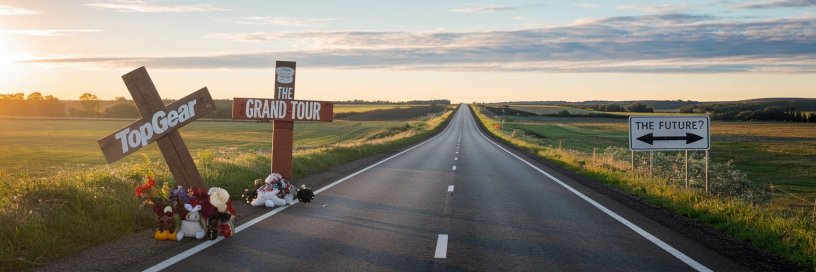
Photo credit: Henry Grantham
Now that both Top Gear and The Grand Tour have reached the end of the road, what next? While Top Gear is on hiatus (re: cancelled), Amazon has announced its intention to recast and continue The Grand Tour. This, as they say, is not my first rodeo. The first time was shortly after the disastrous 23nd Season of Top Gear aired. In that article I went through the steps they could take to right the ship. This time, my advice (for both shows) is a bit different.
It’s not about gags. Not stunts. Not track times. Not celebrity guests. Not big personalities with bigger opinions. It’s not even about cars.
In order for continuations of either Top Gear or The Grand Tour to succeed, the new show runners need to realize what Wilman, Clarkson & Co. understand: the most important thing is story. Everything must be in service to that. Period. The ability to tell engaging stories is what made Top Gear and The Grand Tour great, and drew an audience that went far beyond car nerds.
Let’s take a step back.
A Car Show That Isn’t About Cars
The original Top Gear (1977-2001) was a car show. The brainchild of Derek Smith, it was a pitched as a magazine-style show that would focus on road tests, consumer advice, and motorsports.1 Originally a regional, monthly program, it was picked up by the BCC to be televised nationwide in 1978.
This version of the show saw increased popularity on BBC2 starting in 1988, with the introduction of former Formula One driver Tiff Needell and motor journalist Jeremy Clarkson—who brought his trademark bluntness and bluster to the show. He left in 1998 due to creative differences. By 2001, the ratings had declined to the point of cancellation.
In 2002, producer Andy Wilman and Clarkson came back to rework the show. The rest, as they say, is history.
Meanwhile, several of the hosts of the former version (Needell, Butler-Henderson, and others) left to create Fifth Gear. Viewership numbers are not readily available, though it is in the millions2, but less than TG. This show sticks to the original formula of reviews, consumer advice and road tests. You won’t see them doing the sorts of things that ultimately lead to the demise of Top Gear, but neither are you going to see what got Top Gear into the Guinness Book of World Records3. It’s pleasant, filled with useful information, and moderately entertaining, and well worth a watch—but it doesn’t tell anyone’s story.
Cars Are The Means, Not The End
Have you ever listened to someone’s life story, or of a particular instance in their life, and instantly felt empathy, a connection with them even though they’re a radically different person than you? That’s the power of narrative. A great storyteller can take something unique and individual and make it relatable to a wide audience.
For example, listen to this story about how Casey Putsch decided to build the only turbine-powered Batmobile. He spends very little time talking about the technical aspects, but spends the majority of the time talking about the journey he went through making it and the experiences he had when it was finished. It’s a great story, and it’s the sort of thing TG and GT did brilliantly and regularly.
Everyone has a story4. Not everyone has a Ferrari.
Experiences, Not Gags
People love the ‘Challenge’ episodes, but not for the reasons most people think. It isn’t for the sake of doing something outrageous with some esoteric bit of automotive hardware. Let’s take the Ford GT vs Airplane example. That is a challenge that can be done in your family car. As Hammond pointed out, there was nowhere in Clarkson’s journey where he could drive 200mph. In fact, a Honda CR-V could have done the same trip with only one gas stop, and have been done in far more comfort. Many of the best, most entertaining challenges of TG and GT used cheap cars. Even when the Trio took a bevy of hypercars, the films were still about the experiences they had in those cars rather than the cars themselves.
Other challenges picked the ‘wrong’ car for a task, which mirrors the fact that most people can’t afford to have specific tool cars (dedicated track car, off-road car, camper, etc.) but must make do with a car that can do it all. And we’ve all had a friend who took a Civic off-roading, or auto-crossed a Volvo. We call them crazy as they go off and succeed or fail spectacularly, and everyone laughs afterwards as the story is told over beers.
Art and reality met when Clarkson bought a Ford GT, and went on to experience buyer’s remorse in real time. You don’t have to buy a supercar to relate to that.
Many times the trip was about the road, or the scenery, the culture, the history, the people, or all of it together. Like a good James Bond movie, you learned something interesting and gained a worldly, sophisticated perspective at the same time as being entertained. And yet the sights and sounds trigger the nostalgia centers in our brains, reminding us of the road trips we’ve taken with family and friends. It’s new and exciting, and familiar and comforting at the same time.
What To Do
- Slow your roll. Don’t expect instant success. Top Gear (and even Grand Tour) was not created in a day. The worldwide success took time. The personalities and chemistry took time to gel. Like a good stew, the elements had to simmer, the bad bits scooped out, and the good bits built on, emphasized with a dash of this or a pinch of that. TG took 2-3 seasons before it was really firing on all cylinders. Don’t expect to do better.
- Find the right hosts. TG made the mistake of using the shotgun approach for season 23 and… it didn’t work. I would say it lacked focus, but it didn’t. It focused on Chris Evans as he was the shoutiest person in the room and drowned everything and everyone else out. If you don’t get the hosts right, the show won’t work. Period.
a. Three to five hosts, max. Five can work5, but as in any scripted show, when you start having more than five main characters, it is hard to give everyone enough screen time to develop and for the audience to connect with. In real life, you only have so much time to spend with friends, an can only connect meaningfully with a small number when given a finite amount of time. A show is no different.
b. They must be relatable. So no influencers/celebrities/athletes/actors/singers/millionaires, etc. They have to be ‘normal’ people. They should remind you of your cool uncle with the old ‘Stang, the friend who knows where all the fast, twisty roads are, the friend who always does their own maintenance or always has a project car, the sibling who loves road trips, the father who taught you the love of the Sunday drive, etc. On the other hand…
c. They should be kind of cool. Not like a pop star, and definitely not in the hipster sense. They should have the confidence and self assurance to let you know you’re in good hands, yet self-conscious enough to let you know that they’re in the same boat (car) as you. They can’t be entitled, snobby, or ironic but at the same time can’t be seen as shills or sellouts. They must have the courage, expertise and studio backing to speak their mind, regardless of consequences, much like how Clarkson took on Tesla6 or how John Oliver took on Bob Murray7.
d. The hosts must have chemistry. Just as normal, scripted shows screen tests actors together, you need to ensure that your new hosts have chemistry. Can they make the others laugh? Can they get under each other’s skin? Not every host has to best friends with every other, as creative friction can result in memorable moments, but they do need to get along. After all, this isn’t Real Housewives, or The View.
e. They need to understand and love story and be great storytellers. All three of the Trio are great storytellers in their own way. Their background in journalism was a big part of it, but skill and training as TV/radio hosts is every bit as important, and they all are great writers. We need to hear their voice. Further, a host can’t just talk enthusiastically or with animation, they must be able to use the eye of the camera to engage their audience, and speak with and ear for narrative flow. Listen to Richard Burton talking about his childhood on the Dick Cavett show, for example. A gifted storyteller is captivating, and Clarkson is an absolute master. These same qualities also made Clarkson an outstanding interviewer, giving his guests the space to speak and knowing when to interject a question or anecdote to keep the story going or emotionally emphasize a point.
f. They need to have distinct personalities, opinions and expertise and the ability to express them—not be ‘types.’ Ask a fan to describe James may and they’ll say things like: slow driver, bad sense of direction, pedantic, slightly OCD, and so on. All three can be described in vivid terms, but it is a mistake to distill them down to ‘types.’ American Top Gear did this, going so far as to tag the presenters ‘The Driver,’ ‘The Expert,’ and ‘The Wrecker’ in the credits. It didn’t work. DO NOT try to get a Clarkson type or May type or Hammond type. Don’t fall into the trap of thinking that the audience will only accept someone exactly like them. To do so is to say that only those three people can tell stories, which is preposterous. The way that people relate and think about cars has changed in the 20+ years since the Trio started doing car stories. It’s time to move on and find the voice(s) for the new generation, but who are also capable of having an eye on the past.
g. They need to wear their hearts on their sleeves. All three of the Trio were (and are) transparent about their emotions. Whether it was in the childlike joy they showed when going sideways around a corner, the misery of a particularly difficult location shoot, or their camaraderie or irritation with each other when a joke went too far, it was out there for everyone to see. This gave even Clarkson a certain vulnerability that invites you emotionally into the show—because it was real. - Throw away the rulebook. What was done by the Trio or on any other show needs to go out the window. The new hosts need to create a new rulebook. Their rulebook. This will take time as they get to know each other, their strengths and weaknesses, and learn how to play against one another. The only thing that should stay is that the show involves cars. Do not do something because it was a popular element of the previous shows. This will only force a comparison to the previous shows, and you will lose. If, however, a similar segment is crafted that plays off the unique personalities of the new hosts, it will still draw comparisons, but it will be organic and natural enough that people will come to accept it.
- Go back to basics. For at least the first season or two, go back to basics. Have the hosts drive all sorts of different real-world cars in real-world situations so that we can naturally learn what they think of, say, minivans, or motorcycles, or sports cars, what kind of driver they are, and so on. Let us learn who they are through the context of cars the general audience can relate to. The fact that we’ve seen The Trio drive normal cars in everyday circumstances (and celebrities in the Celebrities in a Reasonably Priced Car segment, for that matter), often praising affordable cars (Clarkson the Golf, all three the Mondeo) brought them down to a relatable, human level. This could be one of the reasons no one begrudged any of them driving or buying supercars. They were ‘one of us.’
- Last but not least, Story, Story, Story! Even a review of the cheapest MPV can have a story behind it. Driving the wheels off a hypercar while spewing superlatives isn’t enough. In fact, it’s boring. There are innumarable Youtube videos of rich assholes doing exactly that. All the best segments of TG or GT have a narrative or narrative subtext: The meta commentary of the ‘Unscripted’ episode of GT, the indestructible Hilux, Funeral for Ford, the various car vs challenges, the British sports car challenge where they visit the TVR plant, the Botswana special, visiting the faded, former glory of Detroit, the environmental impact of climate change in Seamen, and on and on. There’s the adventure on screen, and there’s the story going on in the background.
Conclusion
There will never be another show quite like Top Gear or the Grand Tour with Clarkson, Hammond, and May, so don’t try. With the demise of the one, and the natural end of the other, there is an undeniable hole in the heart of the car-loving TV viewing demographic.
The good news is that The Trio aren’t the only people who can tell a great story, or capable of great screen chemistry. Theirs are not the only three personalities people can connect to.
Show us something we’ve never seen before. Tell us a story. Take us for a ride. Please. Our bags are packed and ready to go.
Footnotes
1 https://en.wikipedia.org/wiki/Top_Gear_(1977_TV_series)
2 Google AI
3 Top Gear set the world record in 2012 with over 350 million views worldwide https://www.businessinsider.com/top-gear-facts-2021-3#top-gears-large-viewership-set-a-guinness-world-record-6
4 Restoration Rip-off is a perfect example of car-as-narrative, Top Gear, Series 5
4 Mythbusters balanced five hosts well by having a primary team of Jamie Hyneman and Adam Savage and a ‘build team’ comprised of Kari Byron, Tory Belleci, and Grant Imahara, but even that final configuration took a few years to establish.
6 https://www.theguardian.com/media/2013/mar/05/top-gear-tesla-jeremy-clarkson
 Stop drinking the Kool-Aid